When Pathetic is not Pathetic

Since leaving my job due to my health I have felt almost no stress (until I ponder things in the future, so I mostly don’t), and this has helped relax the pain in my neck and shoulder. Doing much of anything is still too much, and doctors have repeatedly emphasised complete rest is the most important thing, continuing my estimation game for when I can do more. Due to this I decided to not even force myself to finish a particular blog. This helpfully allows me to do something I enjoy: starting a whole load of things, mentally being happy with the direction, but not physically finishing them. Whilst I am financially paying for myself to rest, I decided that getting the most rest, to quicken healing, really is still the priority, because then I can return to actually doing some work.

As part of my continuing focus on resting, I have even avoided doing much dictation by speech recognition. I have a massive mental list of blog posts I have pondered writing for a while now:

  • role-playing articles
    • working at KJC Games
    • game design lessons
    • more gaming stories and the lessons I learned
    • my obsession with White Wolf
    • why GURPS is the best thing, yet I’ve never played
    • tidal force role-players
  • the difficulty of doing nothing,
  • energy levels and how to plan around them
  • chronic pain
  • martial arts
    • returning from injury
    • consideration of training partners when you cannot work at your old pace
  • NoobGrind articles
    • Various thoughts about gaming
    • Guild Wars 2
    • Path of Exile

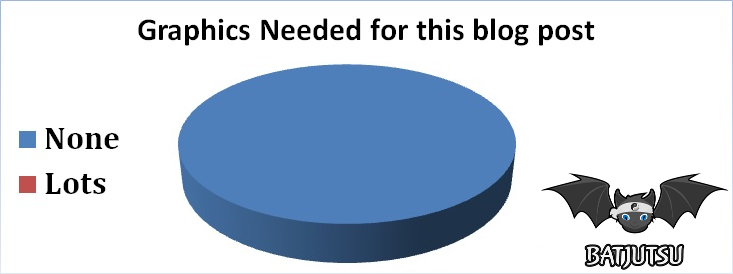
There is an additional reason that I am avoiding finishing any blog posts, since I envisioned graphics that I feel really add to the articles. The problem being, whilst I can make art and graphs to at least an adequate level, they are not areas that I practice much, so it would take me a long-time to get things to a level I am satisfied with. This links to an issue of sitting at a computer for an extended period, I normally have pain in a variety of places, and thus it is not good for my body, nor is it me resting. Pathetic sounding, but it is the reality of my situation.

I’m also aware that my wanting to have graphics for a blog post, it is me entering into the dangerous territory of pushing these partially started articles towards needing to be near perfect. In a way this justifies me not having to do what I can, and then move on.

Graphics Needed
Well, it is still nice to have some graphics.

So I decided to write the above stream of consciousness, at least then I am writing my intent in regards to what I will be blogging about soon, and I don’t need graphics. Whilst I could again use the word pathetic, that should only apply if I was healthy and avoiding doing work. If your best is barely anything, and you are still managing to get bits done, then that is not pathetic.

Wallowing in Positivity

During my bed-rest I contemplated whether to write a post about things, frustration and embarrassment were strong impediments. Since I have been in a long-term holding pattern with regards to work, training, and well, life in general, it felt like writing a blog post was not worthwhile, since it would be full of vagaries without any conclusion. My circumstances have changed and it seemed odd if I skipped the following.

Things get better, things get worse. Psychologically I kept telling myself that this was my situation. For the last year, and particularly since November, my pain levels have been appalling. When there was a brief respite from pain, my optimism would ramp-up, I was eager to get back to training and work and in those moments it seemed like I was almost healthy again. The problem was that the respite barely lasted long, and usually was due to mixing pain killers with a bit alcohol; I had consulted with several doctors about it being okay to have 1 or 2 units of alcohol a day with my pain meds.

Besides the chronic left shoulder, neck and sometimes back pain, along with lack of sleep, things have been made worse by a lack of exercise. The weaker I get, the worse everything becomes. There were times that I felt like I could get out of bed and do something simple, not too strenuous, like a short walk, but when I did so, I suffered. Even the action of walking, was something I had to carefully consider, pretty obvious when you consider how the arms swing, and the interconnectivity of the body. So, was going for a short walk to help reduce my body’s deterioration, and a chance to get out and about a sensible thing to do, when it also could aggravate damaged areas.

It’s strange having to learn how to tolerate switching between being in chronic pain, to that of having a few hours a day when the pain is tolerable. As the pain level lowers I enter a strange mental place: like being at the eye of a tropical cyclone, allowing me to come out of the fortified cellar, however, coming out is a mistake, the storm has not gone! There is also the weird feeling of being both overtired yet having energy and the need to do something. Since exercise correlates with health and quality of life, I am also concerned about long-term health effects. That even after healing I could be facing a year of rebuilding just to reach a basic level, never mind something more athletic.

So, as the shoulder swelling and pain started reducing, returning to work became the target. A previous phased return to work had failed, since I attempted it shortly after no longer being bedridden, but this time I’d had more rest time, as well as a cortisone injection. I saw several Doctors and they advised that if work/lifestyle changes were in place, that preventative measures at work like using speech recognition: Dragon (DNS), that a phased return to work could help. Having a routine should help with my sleep pattern. That moving about a bit would start to strengthen me weak body as well as my energy levels; simply being out of bed for the day was tiring.

The last phased return to work failed. The pain levels had reduced drastically, but even after the cortisone injection I was not healed enough. Also despite new medication I still had severe problems sleeping.

I didn’t want to leave this job, it wasn’t too demanding, I found it interesting, and they even provided assistance to help keep me in work. Working for social services was also rewarding, since I was part of what is effectively the fourth emergency service, which I agree with. A further bonus was talking with social workers, who I found to be overwhelmingly genuinely nice people. It is easy to imagine that it simply comes with the territory, somebody working in a job where they have to prioritise another person’s needs, as well as a client’s capacity, would be a good person. However, given how tough the job is, the layers of bureaucracy (mostly appropriate), and the complexity of figuring out what is best for somebody, it would be naive to think that all social workers must be wonderful positive perfect people. As somebody interested in psychology and writing I’ve certainly learnt a lot from working there, as well as several interesting ideas to follow up on.

Now I am left with more bed-rest, careful physiotherapy, but a positive attitude that things will improve if I keep things simple and sensible. Throughout my experience I have felt like I am a few days away from being fine, when things were really bad, maybe a few weeks; odd to think that I have been wallowing in positivity. At least I have plenty of time to think about life plans.

Kickstarter The PlayStation Revolution

I have written an article for NoobGrind about the new kickstarter The PlayStation Revolution

http://www.noobgrind.com/the-playstation-revolution-kickstarter

I have backed the Kickstarter, and hopefully it will be of at least the same quality as their previous work http://frombedroomstobillions.com/

I wrote reviews of the previous work:

https://batjutsu.wordpress.com/2016/06/13/8-bit-era-review-from-bedrooms-to-billions/

https://batjutsu.wordpress.com/2016/06/19/review-the-amiga-years/

Check it out at: https://www.kickstarter.com/projects/1195082866/from-bedrooms-to-billions-the-playstation-revoluti

Review The Amiga Years

I previously wrote a blog about my review on NoobGrind for From Bedroom to Billions, I would recommend checking that out before reading my new review. Although I suppose you can watch them in either order, but the first documentary does provide an overview of the Amiga, and its place in the overall history of computing.

The Amiga Years, what a great documentary, well I guess that spoils my opinion, but I have written a lot more than this. Before watching the film I decided that I would delay writing a review, this way I would have time to reflect on the documentary; I didn’t want to come across as fanatical. Whilst I expected to be rewarded with another great product, I know it is not uncommon to be disappointed when armed with such passionate expectations. Thankfully I was not disappointed.

My own experiences with the Amiga are mostly focussed around the Amiga 500, although I have had a lot of access to other models. It was also great that by the end of the 80s more people I knew had also started getting access to home computers. My high school days were filled with all sorts of chats and a chance to play games at other peoples’ houses.

By the start of the 90s my dad was running a computer shop. This gave my more exposure to all aspects of computing, but particularly more games. The Amiga packs were a big part of the culture then, and it was a shame when the Amiga sales started getting increasing replaced by the IBM compatible PC machines. The capabilities of the PCs at the time still seemed terrible when compared to the range of Amigas, especially considering how cheap the Amiga 500 had become.

By the time I ran the shop in the mid-90s the Amiga was no longer selling, but thankfully the PC finally seemed to have caught up. It’s odd to recall what a difference there was in specifications and cost.

Given the tribal nature of our species it is no surprise that we form clans around a particular brand. I have been accused of being a PC fanatic, having had the luxury of access to them via our family’s computer business, but the reality is, as I mentioned in the last blog, I have had a lot of different computer brands. Although I’ve had a PC since 1995, if I had to pick a brand to be fanatic about it would be Commodore, and if I had to pick one machine in some sort of deathmatch, were era, cost and capability were weighted correctly, then I would pick the Amiga 500!

The Amiga also played an important part in helping me develop my interes

Please check out my new NoobGrind review The Amiga Years.

5 Positive Role-Play Lessons

Continuing on from the previous articles that started at https://batjutsu.wordpress.com/2016/03/19/cyberpunk-rpg-and-crpg-style-and-substance/

Julian, the Dungeon Master from the high school lunch group I was in, introduced me to Pete I think in 1988. I’d been buying Skaven figures off another friend, who’d gotten them from Julian. They’d been painted by someone Beatties toy and model shop in Blackpool’s Houndshill Shopping Centre, where Pete worked on Saturdays. Even whilst at high school Pete was a great model painter.  I don’t recall specifics about my initial conversations with Pete, but I recall that they were relaxed, and that it was easy to have a dialogue with him, as opposed to him dictating at me like the other older lads did.

1 Explain what something is, not its competitors

Pete explained the Cyberpunk setting well, and I don’t recall him saying bad things about other gaming systems. I grew to appreciate how important that is, focus on what a product is, not on differentiating between its rivals.

Typically, when someone asked about a new game system/setting, theyd ask for some comparisons. Since I was being explicitly asked to compare, I did so. Whilst comparisons can help, even speed up the learning curve, it was all too common that the conversation would deviate in to negative critiques of other products. This could become quite a time sink, requiring further clarifications, dancing around the root of the question. Not only because it requires people to know the other systems, but also for them to understand what comparative point you are trying to make.

I have grown to understand that people are inclined towards defending how they’ve spent their time, it’s natural for people to feel they are being criticised for their choice of game system and setting. This is particularly magnified if they love a particular system. Some (most?) gamers chase their idea of ‘the perfect system’. Whilst I think perfection is something to aspire towards, I don’t think the end goal is helpful; I’m all for thinking and conversation about how things work and what affect each setting and rule choice does to a game. I often found that as we raise more points, things become ever more complicated. The original question can get lost amidst overwhelming information.

The above reasons are why I have found focusing on comparisons to be a poor approach. It can still prove to be an effective way of explaining things, but I’d suggest mentioning as few as comparisons as possible, avoiding specifics. These days I try to focus on more positive aspects, and to stay on target: explaining what a setting and system’s focus is, and its pros and cons.

2 Give things a try

One of the fascinating things about playing Cyberpunk 2013 was the emphasis on other things: how characters talking was typically important, the standoffs, trying to navigate prolific corruption, in a game world full of people in bad situations. With no clear sign of who was good or evil, the fact that so many people were armed and dangerous, plus the finality of combat, it was great to have a reason to talk first, but with the pressure of talking fast.

I appreciated how fun and focused the Cyberpunk games I played in were. This was down to the combination of being in a good group plus having a good referee. This is a lesson I have appreciated ever since, play in games you really enjoy. Years later I played in great D&D games, ones focused on more mature plots; it helped not being kids at school, which once again highlights that the group is the big factor in what makes for a great game.

Don’t be afraid to chat to the group about their play-styles. Try things out and negotiate about balancing your goals with the other players. If you don’t reach a satisfactory compromise, then consider moving on. Since fun is the heart of gaming, don’t torture yourself, or others.

3 Walking through the rules

Pete ran great games, we enjoyed ourselves, and I can recall some great moments even now. Pete explained rules as we went. There was no rush to cram things in to a single session. There was not even pressure to become experts in the long-term. Yet despite not being rule experts, the initial sessions still went well. The lesson I took from this links back to mentoring, which I’ve written about previously. Even if you are playing a simple gaming system, try to introduce the rules in parts, reveal the complexity at a rate the players can cope with. Determining how much is too much is a subtle skill; I’ll explain my opinion on this another time.

I think it is better to introduce things slower, rather than risk overwhelming players. Context is a key part of understanding, and it is hard to provide any depth during an introductory rules overview. Look at how some board or card games introduce rules over time, for example Dominion ignores curses at the start.

4 Letting Go

My first character was a Solo called Thermo, a cool streetwise mercenary with a minimalistic appearance, cliché but fun. Since I knew practically nothing about the setting, never mind the fact that I was just 14 years old, I went with the idea of the character being the strong silent type. Thankfully, it worked well enough, and also helped me learn the game system, whilst helping me to role-play what I had designed.

Similarly, my friends played interesting characters, a few I can still recall even to this day: Black Rain, Jack Deth, along with an NPC Netrunner whose handle was The Idol. Unfortunately, I forget the name of the Fixer played by Michael. This is odd since after playing for a while, Pete proposed Michael and I swap characters. Michael had been playing his character more like a psychopath; not sure the reason Pete didn’t have Michael make a new character, I guess it was quicker to swap.

Within a single gaming session Thermo, my old character had undergone a massive change. The character now had a red Mohawk, painted the back of his leather jacket to show a nuclear explosion surround by lots of flames, with ‘Thermo’ painted across the jacket top. The character was also now quick to resort to gun diplomacy. It was odd seeing my character played this way, but Michael was enjoying himself, so I didn’t tease or correct him. After all I had agreed to the swap, Pete was okay with Michael making the character his own, and I found playing something different to be fun. Crucially Thermo was his character now, I learned to let go.

5 PC Allies can help, just don’t let NPCs take over

A session I still recall fondly was that of the party going to a gun shop, but things quickly got out of hand. Black Rain and Thermo (now played by Michael) chatted with the person behind the security door, but they were giving the person attitude. I’ve forgotten the specifics, but somehow the confrontational chat escalated. Finally, a demand was made for bullets, so a gun was pointed through the security slit at Black Rain, who responded by using the poison dart in his cybernetic eye. Thermo and Black Rain then attempted to shoot through the door; frantic gunfire was exchanged between the shop and the party, but then this stopped. It seemed we had ourselves a stand-off!

Thermo then tried to breach the door with a fragmentation grenade. The thing was that Black Rain was still near to the door and not wearing armour; besides a frag would likely do nothing to an armoured door. Luckily Black Rain was warned of the grenade and passed his dodge roll. The party members took a moment to look at each other and contemplate killing Thermo, but we didn’t. Time passed, nothing was happening, the shock at the escalation oddly hit everyone, and the party become unsure of how to proceed, some still wanted to break through the security door, others wanted to leave before the CyberPsycho squad arrived.

Finally Pete suggested our characters could call The Idol, one of the party’s allies. The Idol quickly arrived and operated as a cleaner; momentum was returned to the game. Crucially The Idol didn’t take over the situation, instead aided, and then as we all high-tailed it, he returned to his own plans. We owed a favour, but the party got a bit of mentoring in-game without being made to feel like they were the sidekicks to an awesome NPC.

Over many sessions the group somehow managed to get things done without drawing the ire of the Megacorporations. But I’ll be honest and admit that I’ve forgotten a lot of what else occurred in the game, it was just too long ago.

I mentioned that Pete was great at model painting even at high school, so it was no surprise that he went on to become a professional artist and teacher. He runs Egg Head Miniatures, check out his work at https://www.facebook.com/eggheadminiatures/ and his shop is at http://stores.ebay.co.uk/eggheadminiatures.

8-bit era & review From Bedrooms to Billions

I recently watched the documentary From Bedrooms to Billions by Anthony and Nicola Caulfield. I thoroughly enjoyed it, and I am looking forward to watching their new film The Amiga Years.

I have posted an article on NoobGrind about it, but whilst writing it I wrote several paragraphs explaining why this documentary meant to so much to me. However, given the size of that article, typical for me, I decided to cut the non-pertinent information from there, but decided to put it here.

My early childhood of growing up in England was dominated by the home computing revolution that took place at the start of the 80s. I was fortunate to have a father who had an interest in electronics, which lead him in to this new home computing hobby.

We started out with a Commodore Vic 20, then upgraded to a Commodore 64; I got my own Commodore 16. A few of our neighbours also got computers, one friend’s house had a Spectrum 48k, whilst another had various Amstrads, and another friend had an Atari 2600. At school we had a BBC Micro. Also living in Blackpool meant I could visit the arcade and compare those machines. So I was exposed to a multitude of systems, and I guess this is why I’ve tried to avoid being dedicated to just one system.

Commodore 64
One of my old Commodore 64 machines. Sadly I don’t have my original one, nor the vast game library I had.

I am not so obsessed with nostalgia that I want to return to those technologically inferior days. I have no issue with retro gaming, my main criteria is that the game has to be good. I acknowledge that some of the games that I have really enjoyed decades ago are of certainly of their era. It certainly wouldn’t make sense to insist that a player in the here and now has to play the ancient games; the term ‘has to’ is nasty. I think even old classics should generally be talked about only in context of their era.

A classic game that can still work well today is Street Fighter 2. It was amazing when it was released, and even with all the developments in the years since, it is still a great game. Whilst Way of the Exploding Fist came out years earlier, and was amazing when it was released, I can appreciate that the game is of its era. I did play it last year and I quite enjoyed it, but I don’t think most gamers would. I’ve previously written about how these two games helped form my role-playing passion, links below.

I ran a computer shop in the mid-90s, and I can recall chats about whether in the future there would be big interest in documentaries about the spread of computer gaming. It was agreed that computing would continue to develop, that interest would increase, but a few regular customers said they thought gaming would always be niche. The majority of my regulars thought the idea that gaming wouldn’t keep expanding was ludicrous, but those who thought gaming would stay relatively small pointed out how biased we were. A fair point to raise, but even back then the game sales figures showed a big trend towards ongoing expansion. This was during the period I referred to at the time as era of the Doom-virus; every PC sold, or even brought in to the shop for repairs, normally went out with the freeware 7 levels of Doom.

 —

Given that I was dabbling with coding from 6 years of age, and trying to learn 6502 assembler at 8, I did ponder whether I should feel regret at not managing to make a game in that time period. I think it is fair to say I was a bit too young for the 8bit bubble. At the time I certainly never heard of young kids making games, whilst there were a few teenagers, even they were rare. By the time I was about 9 years old the Amiga was coming out, at the time I felt like what little progress I’d made had become pointless. When I went to high school at aged 11 I discovered AD&D and other role-playing games, and for many years I had little interest in computing. I actually felt weary of the subject, in part due to the terrible ‘I.T.’ lessons.

A few years ago I read Malcom Gladwell’s book Outliers, which highlights the importance of being in the right place at the right time, and what a small window it usually is. Crucially, since I did eventually go on to study programming and work at a games company, I did achieve major goals.

You can read my NoobGrind article here.

Follow-on review The Amiga Years

Way of the Exploding Fist 3 part series

Part 1 = https://batjutsu.wordpress.com/2015/10/25/noobgrind-article-way-of-the-exploding-fist-is-the-mario-of-8-bit-fighting-games/

Part 2 = https://batjutsu.wordpress.com/2015/11/16/fist-2-on-noobgrind-and-current-life/

Part 3 = https://batjutsu.wordpress.com/2015/12/06/street-fighter-rpg-look-back/


Role-Play meets Lord of the Flies

This post continues on from my Cyberpunk post about my early role-playing (RP) experiences. If you’ve not read that, then I recommended reading it first.

In 1987 my regular gaming group Dungeon Master (DM) was Julian, who was several years older than me. He ran a group of older lads that mostly played during our lunch breaks. We exclusively played Advanced Dungeons & Dragons 1st Edition (AD&D); I think we changed to 2nd Edition in 1989. I think it is important to know that the following story is based upon experiences from when I was 11 years of age, whilst attending a boys-only school. The group was crazy, sometimes a bit violent, and even at times it seemed like a riot was about to occur at any moment! Even then we guessed extreme behaviour still happened in mixed gender schools, but there were rare chats about how girls would have helped the game.

These games were very chaotic and immature, but with enough fun that I kept going back. As the sessions were at lunch they were short, and that was partly why they were so combat focused. Combat was rarely for role-play reasons, it was more about killing sprees to gain loot and experience points (XP). Often sex was coarsely brought up, and the importance of earning gold to pay for a tavern wench. Thankfully nothing about rape, the games were not that disgusting. There were regular moments when players would scrawl over one another’s character sheets, such as declaring that a character had contracted an STD after visiting a tavern wench. The violence was mostly punching one another’s arms/shoulders. I can recall a few moments of wrestling, but thankfully no major violence.

Overall, a bit like role-playing with the kids from Lord of the Flies!

Julian was a good example of someone doing their best to run a game despite all the interruptions, and they were plentiful. Even though Julian was the oldest, he had to put up with a lot of blatant teasing, and even a few threats of violence from players trying to get what they wanted. He was able to weather the teasing, and keep the games mostly on track.

The players weren’t all bad, I remember moments of guidance: rules were explained with a good level of depth, spell cause and effects, and there were even rare chats about in-game culture and theology. It is odd to recall the contrast in the way they treated each other, with the way I was treated. I was teased on the odd occasion, of course, but it was minor in comparison; fortunately it was established early on that since I was younger, and tiny for my age, that teasing me was too easy, and thus pointless. I suppose teasing me was seen as a sign of weakness, which opened the person up from bullying from their peers.

Over the first year I even started receiving a few compliments, stuff like how they liked that I paid attention, focused on playing, and took advice. There was a chat one day that it was good I didn’t argue with them, and I made a good follower; I think this chat got more to the heart of the matter, that I was their sidekick, but mercifully more than a mascot. For the first year I was still paranoid, since I expected to get bullied, but it was nice that my actions to avoid being bullied resulted in praise. In hindsight I think this came down to me not trying to be funny, nor demanding the spotlight, instead I was more focused on playing, but without moaning about things when they did mess about.

Whilst I found that gaming group to be too chaotic, even irritating with its immature fixation on violence and sex, I still had a good enough time that I stuck with them. It was revealed later that I was used as a way of toning down the chaos. I recall a few arguments when I was used as a benchmark, with one player telling another player they were rubbish, since a younger kid could play the game better than them. The truth is: I was a good player due to paranoia and not causing problems, rather than having amazing insight.

d6

The crucial lesson I took from these games is, since the players just wanted to have a laugh, and didn’t care about a lot of aspects of the game (plot, personality), thus it didn’t really matter what Julian did to get them to engage more. We had fun, and given the context of the game and in particular our age, that made the games a success. However, trying to get more out of players who’d made it clear that they were happy with what they had, and no interest in more, was a mistake. What I took from these games was the range of possibilities that I preferred to play/explore, and that it was not a style I wanted to return to.

Ever since I‘ve always checked with players about their preferences and expectations, since personally I didn’t want to return to those two years of chaos and immaturity. If a player said they just wanted to kill monsters, earn XP and collect loot, then it wasn’t for me. In part because I had been avidly playing computer games since I was very young (Vic 20), and I had already played a titanic amount of hack & slash RPG, and I found that even back then most computer games did hack & slash better than school kids.

I have played laid-back games and hack & slash sessions on many occasions since, in particular D&D Living Environment at conventions. Over time I eventually made progress in finding a good balance with respect to players’ opinions/expectations, and the ever fluctuating combination of how much chaos versus order a game benefits from. Next 5 Positive Role-Play Lessons.

Update and NoobGrind GTX 1080 article

I am now fortunate to have occasional hours without any pain, but then excruciating pain in my left shoulder, neck and even arm, can return for seemingly no reason; likely my pathetic amount of activity was too much. Due to this the new role-playing article I have been tinkering with just feels like a low priority. I decided not to force myself to write something, but thankfully something came along and grabbed my attention.

I have been putting off upgrading my PC for about a year. Since my current system does what I need it to do, I have been able to get by. Amusingly I don’t want to upgrade for gaming reasons, but due to how resource demanding Dragon NaturallySpeaking is. Though the software works incredibly accurately the vast majority of the time, there are occasional moments when it struggles.

Last week I finalised a list of parts and sent an email to a company to price up for me. Thankfully they have been slow in responding, which is handy since NVIDIA have announced their new video card range. So at the weekend I watched the presentation and got quite excited due to how impressive the cards are. After a lot of research I ended up writing an article for NoobGrind about them: http://www.noobgrind.com/next-gen-graphics-cards/

The GTX 1080 is certainly more than I need currently. Buying one would be a bit like buying a sports car but then never driving it more than 30mph. However, in the future I do have plans; I will ponder more.

I hope to have a role-playing related article finished in the next few days. I’ve had a few really interesting ideas recently about my decade long unfinished guide, motivation to do something without that is growing.

5 Lessons from my first Role-Playing Session

Oddly I’ve not role-played for nearly a year; it’s quite odd considering how much I have played every years since I was eleven; amusingly my speech recognition thought I said “since I was elven”. Whilst I have been resting, trying to heal, I have been rereading my unfinished role-playing guide, as well as some old anecdotes. This article follows up on my role-playing introduction that I wrote about in role-playing and cyberpunk, I recommend reading that first.

I have written the following about my origin in role-playing to help explain why I emphasis certain aspects. My intent is not to be preachy about what people should do or prioritise; I long since stopped viewing role-playing as a competition.  Whilst I have my preferences, I strive to adapt to different situations, other players’ preferences, and of course moods.

Mr Knowles ran the Warwick High School role-playing games (RPG) club. In 1987 most of the club members played Advanced Dungeons & Dragons 1st Edition, and that is the system I spent the first few years playing. I was aware of other games being played at the club, such as: Traveller, Palladium, as well as board games such as Chainsaw Warrior or Star Warriors. Coincidentally, about 5 years later I got to know several of the older lads I had seen at the club, one became a close friend, and another became my boss when I worked at KJC Games.

During the first week of joining the club, several of us were allowed to play during our lunch breaks. We got to try out tiny scenarios, to learn mechanics with context. I got a bit more explanation about the concept of in-character (IC) and out-of-character (OOC) from Mr Knowles, as the concept seemed paradoxically easy and confusing to my eleven-year-old mind. That week I also met the older players in the group run by Julian that led me to Pete, which I had mentioned in my cyberpunk article.

Batjutsu old D&D, AD&D

My 1st Campaign Session

On Friday the RPG club had its weekly official sessions. For my first Friday I took part in a game that was a big leap for a novice, I was given a level 7 Illusionist! I had barely learnt the core mechanics, yet I was being given an experienced character, and I was expected to know what my spell list was, what the character should memorise, never mind crucial campaign information like monsters and social knowledge.

In a busy science class room, a small group of eleven-year-olds were crowded round a long lab table; I wish I had a picture. We were being mentored by sixteen-year-olds, well more like tolerated. I vaguely remember later talking to a few of the players, trying to figure out why these older lads had agreed to be mentors when they clearly seemed disinterested in more than teasing our inexperience. Playing was more like being dragged along a semi-interactive cut scene, with random dice rolls being called out for the strangest of incidents, like an archaic set of quick time events.

Looking back now this first session had the typically bad introduction, the Dungeon Master (DM) listed off a bunch of made up nouns in quick succession, and no context was given. Even if we had been playing first level characters that we have made ourselves, we would have still struggled to grasp what was going on. I don’t recall there being a discussion about backstory, plot arc, personality traits, how this existing party dynamic worked. After all, we were given level 7 characters that had allegedly been played for years in the same group.

After a few random encounters the game resulted in our characters being stranded in the wilderness, in winter, on foot, whilst a blizzard was raging. The characters kept travelling, and soon they were days from anyway, they had run out of provisions for fire, and had no shelter. The mentors or DM didn’t have much of an explanation as to why we had been led into this blatantly bad situation; we had just been told that we had to move quickly to catch up with our target (insert random noun).

The phrase “Winter is Coming”, reminds me of this gaming session. A weak quirky association.

So, each IC day a party member took turns begging for divine intervention. A percentile role of 1, was needed, except the cleric needed a 2 or less. Obviously given the statistical chances required, the rolls failed.

A single 1% is hard enough, requiring several rolls?

Eventually after days of failing, and with the party members near death my character, I enquired as to whether my character should be praying to the pantheon as opposed to an Illusion God. The DM made a secret role and declared my character’s thoughts were perceived as blasphemy, a lightning bolt struck my character destroying all clothing, equipment and leaving on 1 hit point. My character then sacrificed themselves in an act of  penance, to have a bonfire lit to save the rest of the party; I had been told my character would die in moments from exposure. The older lads were in hysterics, and apparently I had made a classic mistake?

“HAHA you died due to the DM rolling a dice for suspect reasoning!”

Afterwards I spoke with some other players, a few thought it was hysterically funny, which given the maturity level of eleven-year-olds wasn’t surprising. Thankfully a few other players were not mean, and in fact they thought the whole thing was ridiculous. It was highlighted that since my character was good and worshipped a good god, it was very odd that a good god would kill a character for a thought, never mind the fact that worshipping different gods in a pantheon should be normal.

Importantly this incident raises a key query: why was regularly pleading for divine intervention required? If it was common, then surely the population would have an idea of the types of results, and a level 7 character with high intelligence would have some understanding of their own culture, an every-person knowledge.

I’ll refrain from ranting about a DM having cognitive dissonance in regards to requiring a skill roll for a scenario that they made and are running, whilst claiming they are not involved in decision making. Never mind my thoughts about fudging results.

This incident helped me learn about role-playing, both good and bad points. I will focus on the few key lessons that became a big part of my role-playing opinions.

1. The importance of IC and OOC knowledge.

I have been obsessed with this ever since, including working on my own program to aid in tracking it. Whilst working at KJC Games, a core part of the mechanics I made for Quest GME was about tracking the vast information in the different Quest game worlds. With paying customers to consider I prioritised this aspect of the game, since information is power in any scenario, with play by mail (PBM) games it tends to more so due to the heavier focus on strategy. However, I am lenient with myself and others in less professional games, without the tools to track things it’s no wonder that even amazing players can slip up.

2. Mocking players about character death.

Understandable a player that has lost a character is going to be upset, they really could do without the teasing/bullying on top of it. I appreciate that a character death is a big deal, and thus it is often discussed with a high level of emotional energy, but even in PvP at a big live action role play (LARP) game, a bit of respect should be considered.

3. Mentoring new players.

I think it is important to give a new player a good introduction to a game, a chance to immerse themselves in something new. At a small tabletop group level, letting someone join a game is not required and generally a rare event, so it is odd when DM/GMs don’t assist new people. At a large level, like a big LARP, well veteran players stopping a new player from joining is not possible, so why not help make a new friend and at least not make an enemy.

4. Being forgiving of ideas and actions.

This has served me well in all scenarios, from one of my local groups, running games at conventions, to receiving compliments from paying customers at KJC Games. One of my favourite incidents was helping to prevent a civil war due to a player using the wrong ID code on their ships targeting list, but I checked with the customer to make sure instead of assuming it was wrong, after all it could have been intentional. It is much harder to do this at LARP, but even in large LARPs there can be windows of opportunity to check things.

5. Plot Centered Around Multiple Fake Difficult Rolls

Not understanding statistics is a common human problem, the subject is counter-intuitive. I have come across a lot of role-players who do not appreciate the impact of dice rolls, or other random mechanics. Whilst a lot of gamers are good with numbers, statistics is subtly different. Thankfully I have met many gamers who are good with statistics, like with everything else, the population can be represented as a bell curve.

In hindsight I think the whole scenario of spending days in a deadly blizzard praying for constant divine intervention to be not just forcing deus ex machina, but doing so repeatedly? That’s some outrageous odds, and it turns out the whole scenario was fake, since the party was rescued by NPcs, more deus ex machina, and not very player-centric or heroic.


With great role-play comes great responsibility

Yesterday I read about events that had taken place at the recent Lorien Trust (LT) event of live action role-play (LARP). Even though I have not played LT for a few years, it briefly made me cry.

The story of Lady Fama finally came to a dramatic conclusion; a character played by the lovely and talented Liss, whose group I had been in for a few years. I shall keep the overview brief, as I guess only the people involved would care about, and know, the depth that I am skimming over. Plus a lot has happened since I last played.

For years I had played my character, Stalik O’Mite, as an independent, spending most of my time at Guilds. Things changed a lot for me when I joined the Cerebelli group, and it was immediately obvious this was a special group. I enjoyed my time with them, even though I was still mostly at the Guilds. I barely spoke with Liss out of character, and I regret not getting to know her more, we were all so busy. Stalik had many roles as a house servant including scribe; two examples of my work can be found here. When a prominent character retired there was a big IC event, and the following was declared:

“This time next year there had better be tales about Prince Firenzi!” Those were the words of the Unseelie King of Arcadia, Oberon, as he escorted the Prince back to Arcadia at the Summer Moot in 1110.

In my mind I have two images side by side:

  • The player, Liss smiling and saying hello when I arrived at events. A quick chat before we both rushed off to sort out our kit and say hi to other players.
  • The character, Lady Fama with her white frockcoat and trousers, long boots, a distinctive blue waist coat. Her hands clasped firmly behind her back, walking somewhere to do her duty, bound by oaths and a solemn quality.

Fama walking

As a Fae with strict Oaths, Fama’s actions were bound tightly, with conflicting demands; she always seemed so well controlled, but there was something dangerous being controlled. Lady Fama had a close relationship with her brother Lord Aeneas, it was generally considered that she kept him in check; I knew this was not so simple, that Fama’s spirit was powerful and thus complicated. When I found out that Lord Aeneas had died the previous year in a ritual it was upsetting enough, but at the time my thoughts were about how Fama would handle this.

I choose to stop playing LT for a list of reasons. I made a difficult decision, but it wasn’t until hearing about Fama that I really regretted stopping. I wish I’d spent more time with a group that I knew was awesome; I didn’t have a problem with my group, all the members were great.

I was happy that I got to read Liss’s overview of what occurred, the scale of events leading to such a great ritual. The fact that the Cerebellis managed to avoid their stories turning in to nightmares was noteworthy. I felt the need to write something, but since I have not played LT for the last few years, I clearly could not write an IC piece like I had written for Firenzi.

I contemplated explaining why reading Liss’s overview was so moving, but I decided it was not my story to tell, and I would be repeating an overview that I was not present for. Instead I recalled a list of great moments of personal interaction between Stalik and Fama.

A noteworthy interaction between Stalik and Fama relates to the Firenzi article:

this article was undertaken at the request of Lady Fama, of the Teutonian House of the Serpent. King Oberon’s threat notwithstanding, Lady Fama wanted the events noted anyway.

As a house servant Stalik was a loyal Sluagh, and willing to go that extra mile. Whether running a tea party with an assortment of Seelie & Unseelie cheese, gathering information, or carrying out the rescue of a fallen house member, there was so much to do. Before his ritual, Stalik’s whispering voice was not heard, nor his opinion sought. The power relationship between the ruling Sidhe and their servants was as one would expect. However, when Garret started spending time with Fama, Stalik deduced the nature of his intent and asked Fama about this. A restrained, tolerating brief line of questioning was followed by an order to not mention it again. It was not unexpected, but hurtful given the duty to assist. It was a good example of the brief but regular intense interactions; such is the power of Sidhe and the lesser Fae.

Fama Haven

For those that did not come across Lady Fama at LT it will be hard to appreciate why I hold the character, and the player, in such high regard. I am sure most role-players have a list of fellow players they admire, and I am not trying to claim that Liss is peerless. LT is a large system, with a lot of players who are great role-players and lovely people.

It is human nature to focus on the negative, and it seems all too common for role-players to try and outdo each other, often involving grand tales of surviving/tolerating terrible players. Thankfully having gamed so much, as well as professionally, I learned to appreciate that cool stories are what matter. I truly rate the story of Fama as one of my favourites, such an appropriate thing for a Fae in LT, and I appreciate there is so much I don’t know. Another part of my reasoning is the amount of role-play that Fama created for so many people; as Stalik I got to witness so many great encounters, and ramifications a few years later.

I am sure numerous groups are making lovely offers for Liss to join their group. Whatever she role-plays next will be great, and quite possibly become something exceptional. To found out more about Liss, and another reason why I respect her, check out the wonderful everwalker blogs. Since Liss is a writer I hope to be able to read a book about the full Fama story in the future, but given how many Fama machinations are likely still ongoing, it may be a while.

A special mention to the whole group, several of whom are pictured below. A great group of role-players. Without great members playing less socially powerful roles it would have been much harder for the Sidhe players to appear as important. I was complimented a few times OOC by important Fae in other groups for making them feel special, and as someone of genuine high rank. With great role-play comes great responsibility, and this is something that I found Liss did well; IC as Stalik I was her servant, OOC I was a valued member. The same with the rest of the Sidhe, it was normal to be asked what we wanted to achieve in game, to be assisted in getting there. Even better the Sidhe characters were often able to deliver, making both the IC and OOC relationships stronger.

PS – My Fate Sucks!

Court group

Design a site like this with WordPress.com
Get started